

Encountering Thin Places: One Priest's Hope in the Modern World
A Conversation with Andrew Teal

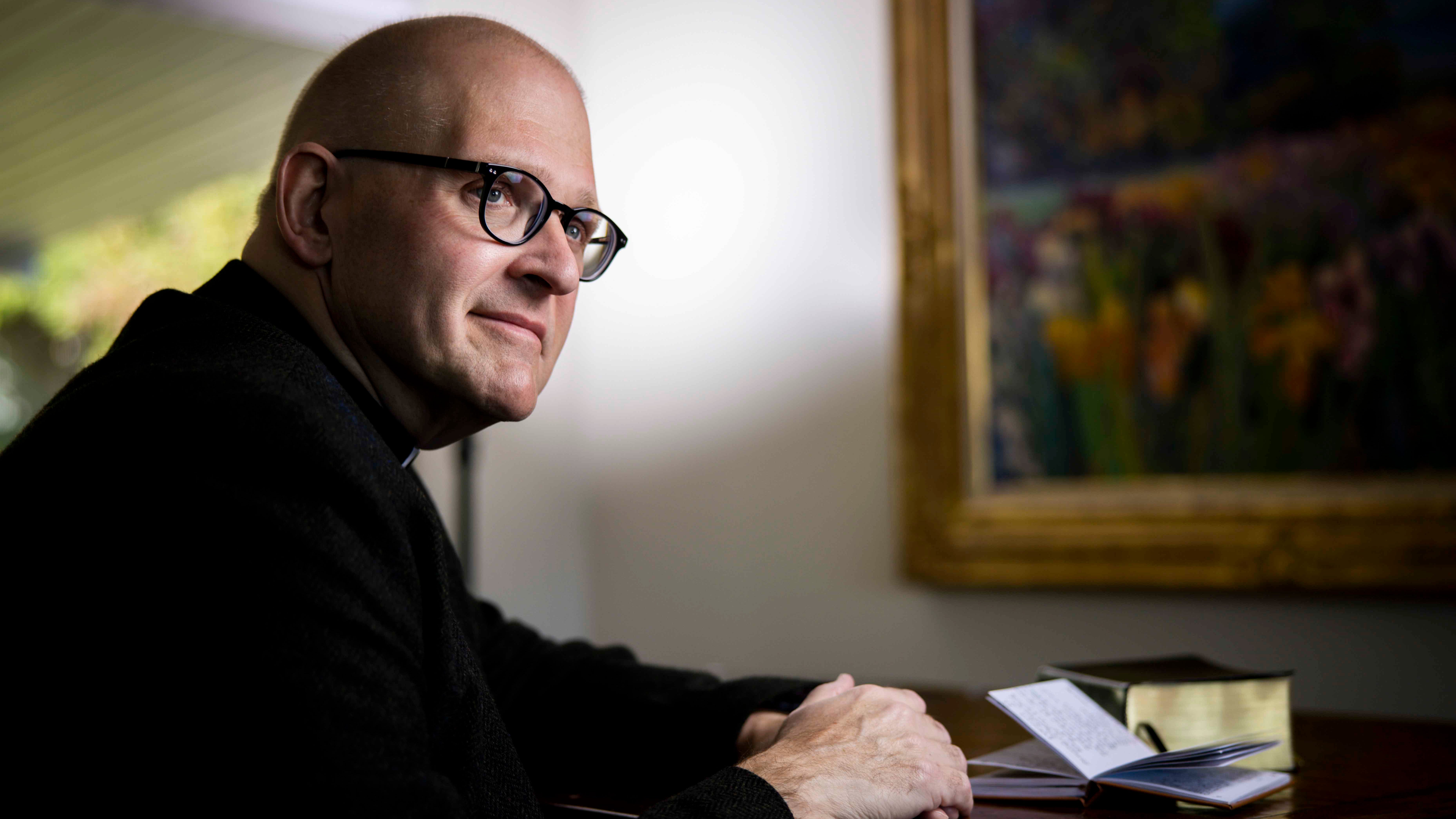
Reverend Dr. Andrew Teal grew up wandering the ruins of Fountains Abbey in the UK—one of his "thin places." After he was ordained an Anglican priest in his twenties, he learned to find the sacred as easily in seminar rooms as on the side of the road. Teal believes in the power of inhabiting the world, be it through philosophy, poetry, or simply your presence.
Guest
The Revd. Dr. Andrew Teal has been a full member of Oxford’s Faculty of Theology and Religion since 2008. He has been an admissions coordinator, disability officer, harassment advisor, and teacher of New Testament Greek across the university and a Pro-Proctor of the university for two seasons. He is chaplain, fellow, and lecturer in theology at Pembroke College Oxford, teaching historical and systematic theology; the history of Christianity; and the study of religions, with research interests especially in patristic and modern theology, Christology and ecclesiology, Eastern Orthodox theology and interfaith dialogue, theology and the arts, and theology and frontier spirituality. He is especially committed to furthering theological understanding in dialogue with The Church of Jesus Christ of Latter-day Saints.
Transcript
Marcus Smith: I am Marcus Smith, and this is Constant Wonder. Join us as we quest for the awe and wonder of knowing we are part of something infinitely larger than ourselves.
It’s overwhelming to contemplate the vast distances of the cosmos. We can feel this immensity and great humility, as did the ancient psalmist of the Bible who wrote, “When I look at your heavens, the work of your fingers, the moon, and the stars that you set in place, what are mere mortals that you concern yourself with them?”
On the flip side, we ‘moderns’ are more often pretty heady about ourselves. We think we’re capable of mastering those giant cosmic distances, bridging unbridgeable chasms, crossing uncrossable divides. It’s also very Star Trek— going boldly where no man has gone before.
A recent prime example? Astronauts have now journeyed all the way to the moon again, for the first time since Apollo crews pushed out into the deep. I’m not gonna deny that it’s an impressive accomplishment anytime humans venture out into space and return alive. But I’ve been thinking about a kind of journey far more stunning: namely, the quest right down here on earth to bridge our immense existential estrangement from the natural world, our distance from others, and of course our alienation from God.
With this episode of Constant Wonder, I invite you to consider with me what it would take to close such enormous gaps as these.
Reverend Dr. Andrew Teal: Whenever it rained, he got a reputation of being quite crazy. He would run out into the rain and lie on the floor and watch the rain drops splash on, on the granite pebbles because he liked the refraction of light. He liked what it did to the stones.
Marcus: That’s the Reverend Dr. Andrew Teal talking about the poet Gerard Manley Hopkins. I found a kindred spirit in Andrew Teal, even though he lives at a great remove from me on the other side of the world. It turns out that we share a love of nature, music, art, poetry, theology, and more.
This Englishman has dedicated his life to mending human alienation, and by that I’m talking about separation from each other, from creation, and from God. If only we could bridge these kinds of distances.
Rev. Teal: You see moments of little growth in people, tiny little shoots of hope, and you feel that actually they’ve managed to grow through a thick crust that life is laying on them and that they are pushing out into the deep, transcending the inhibitions of life.
Marcus: The Reverend Dr. Teal is an ordained Anglican priest and currently serves as a chaplain and lecturer in Pembroke College Oxford. But I’ve gotten to visit with him a couple of times on this side of the pond. Andrew Teal hails from Yorkshire, but has grown very familiar with my own home turf right here in Utah.
Back in 2019, he was invited to speak at Brigham Young University, and then he returned in 2021 as visiting faculty. The wide-ranging conversation we taped with him for this episode of Constant Wonder was easy to do because of his breadth of knowledge combined with a completely approachable manner.
My MO whenever I prepare for any Constant Wonder guest is getting to know as much as I can about their background. And with Andrew Teal, I quickly knew exactly where I wanted to begin our exchange. I was sure he’d be game to begin with a story or two of his personal experience at a place very near and dear to his heart: the Gothic ruins of Fountains Abbey, which is the largest monastic ruin in all of England. This is a site that figured prominently in his childhood and which he visits often still today.
Now, you need to know that Fountains Abbey, or what remains of it, has only the sky for a roof. It was founded in the 1100s, but destroyed some four centuries later by King Henry VIII, along with over 800 other religious houses.
Eventually, in 1742, the property on which the ruins of Fountains Abbey stand was purchased by a member of the English House of Commons by the name of William Aislabie. William’s father, John Aislabie, a prominent politician in his own day, had inherited the estate surrounding the Abbey with its expansive country garden.
John was among the first in England to experiment with natural landscaping on any grand scale, and he got very creative in his shaping of an incredible water garden adjacent to the Abbey. These ruins and their verdant setting are a UNESCO World Heritage Site. It’s a picturesque, though somewhat haunting place, and it has held a lot of meaning for Andrew Teal ever since he was but a Yorkshire lad.
Rev. Teal: When you walk around Fountains Abbey, you could almost be in any era, and it feels more as if you’re walking through a grainy, black-and-white photograph. It’s a stunning building. It’s a place of great aspiration. Monks came and lived in this valley just south of Ripon in the West Riding of Yorkshire, and it became one of the most flourishing places of faith and social care. One of the things that the abbeys did in England was that they looked after a host of people who’d fallen through the very basic social welfare networks. And so it became a sort of place where people would go and be fed and uh, have some sort of shelter.
But in the English Reformation, this was resented and exploited by an English king who established the Church of England and dissolved the monasteries. And the result is sometimes, you know, in death, there is a beauty that you don’t see when things are busy and in life.
And Fountains is like that. The last time we were there was in January of 2026. We spent the whole of Christmas there. There’s a place called the West Lodge, which is a very beautiful little stone cottage off the grid. There’s no wifi, there’s no phone signal, so it’s heaven in many ways. And you are in this place, this enormous world heritage site. You could wander up steep paths. There’s a river that runs through it, then goes from the ancient abbey into a more formal garden setting. I’ve been associated with Fountains Abbey since I was about eight when my grandparents used to live nearby, and always, every 26th of December—we call it Boxing Day—there’d always be a walk around Fountains Abbey. So it has tremendous, intimate memories of being a child, of being with people that you love, of being in a place of sadness.
One of the things that I heard walking around on one of the days that people were allowed was, “What great tragedy happened in this place?” I think they probably had an image of masters of the universe battling over something. But how, right? But what that great tragedy is, is human division, and suspicion and the exploitation of distrust.
Henry VIII was a great exploiter, but it is a tragedy when we do that. And yet this is the… this sounds so maverick, that actually there is a beauty that’s revealed through that tragedy that you don’t often see if everything’s just working successfully, but to just be there, to let the damp penetrate through your clothes, so when you get back to the thing you’ve got to strip off and dry off.
But it was just lovely for me and my wife to be able to be away from the madding crowd. And to be able to spend Christmas for the first time… I’ve been working as an Anglican priest over Christmas since 1987. So that was a well-awaited bit of a break.
Marcus: The closest thing that I can even think of in my own experience that would relate to that was years ago. In 1986, I visited the ruins of a monastery in Soissons in northern France. I think everybody has some acquaintance with these pictures of the tall columns of a gothic church, but the roof is caved in or there’s a colonnade or you might still see the empty space where the stained glass once was. And I know that from my schooling that the romantic writers and poets were just enamored with these places. I think for the very reason that you mentioned.
Rev. Teal: Wordsworth wrote some wonderful words on that, in the ruins of Tinton Abbey, and they do trigger… I mean, you touch the cold stone, you notice how lichen has made little white patches when it’s died off against the gray stone.
It’s not the beautiful sandstone that you see in, I dunno, Southern Utah or Oxford College buildings. There’s something resilient, something not bleak, but gritty about the place. It has a great poignancy for us. We’ve often been there on holiday.
Marcus Smith: Were you like me? I was a weird little kid. And if I went to a place like this, and of course I grew up in the American southwest, in California, and trips to see the family in Utah. But if I saw something that we would’ve called ancient that was weathered, that was a building of stone, maybe in a ghost town even…
I remember going to a ghost town near Leeds, Utah. Leeds is a name you would know, but not from Utah. Little tiny town of Leeds where there was an old silver mine and there were the ruins of a building. And I was a weird little kid because I felt the place.
Rev. Andrew Teal: Yeah. I did as well. When I used to go there as a kid, it was almost as if the lives of these monks, the lives of the poor people who wandered around the countryside trying to eke out a living by begging, all of them somehow were held in that place with a sense of their dignity. Everything had happened to them, and yet their dignity was celebrated in these silent stones.
One of the things that really shocked me was when I first came to Salt Lake City, I was shown around a place, which is the family center, and somebody had done lots of work on my family.
Marcus Smith: So you’re talking about genealogical research?
Rev. Andrew Teal: Yeah. And from that, I discovered that I have an ancestor, a direct ancestor, who was Lord of the Manor of Fountain Abbey. That was a strange connection that actually, you know, might it be then, that there’s not only that real connection to the emotional and imaginative connections to the people who live there, but actually almost a genetic one?
Marcus Smith: That’s a weird story. I’ve the word, I’ve used the word weird too often but…
Rev. Andrew Teal: It’s good. And it’s weird. It’s very sad because, in fact, he spent all his life’s resources on gambling and alcohol and wild women, and he lost it all. And that’s the sort of thing you think that’s part of the tragedy that each, within, each one of us, even though we aspire to see that which is best to preserve, um, that which is beautiful, there is this other, dark side within us.
My relative’s name was Messenger, which is interesting and appropriate, really, because his life, as I discovered, was a sort of message that there is within us that capacity not only for great good, for incalculable good, but also dreadful taint and destruction.
And there is this necessity to be an agent, to preserve your dignity and the right you have to choose. Are you gonna choose to be like the monks who lived there, to serve those who were poorest, those who had made bad life choices, or are you going to choose to be like my ancestor, Mr. Messenger, who chose another path, which was that of self-interest and hedonism?
Marcus Smith: What’s it like to have known Fountains Abbey in your childhood, and then as a grown man decades later, discover this connection to Mr. Messenger at Fountains Abbey? I can only imagine you letting out a little bit of a shriek.
Rev. Andrew Teal: It was a bit of a shriek and it was, well, the difference, I think, between immediate experience and genetic experience, actually, we are at the cutting point between the two. It’s not just those things that happen to us as external stuff, but they trigger stuff, which is our identity. That part of Yorkshire’s always been connected with the experience of love and loss for me.
Not just the imaginative losses and loves of people who lived there before, but also personally. I lived with my grandparents because my parents were divorced when I was being born, and we used to go up there regularly. And when my grandmother died, it became a shrouded place on the earth.
A place where the veil between us and our dead is very thin. Because that had been established with the stories of those who’d lived there and been dispossessed. And when Rachel, my wife, and I went up there this Christmas it took on a new dimension. We discovered, not when we were there because we were off the grid, but a dear friend of ours, one of our most wonderful friends, had died on the 27th of December, here in Utah.
Marcus: On the far side of the world from Fountains Abbey, the Utah friend whom Andrew and Rachel had lost was a prominent leader in the Church of Jesus Christ of Latter-day Saints named Jeffrey Holland, and a former president of Brigham Young University. The Teals actually did not know of his passing until after getting back into cell phone range in a tiny, nearby village called Pateley Bridge.
Rev. Teal: It was one of those moments where it was safe to just be silent. The sense of shock when you lose somebody, you—you are pushed, if you are a very close relative, to sorting out the funeral arrangements, to clearing houses or to connecting with people and letting them know. But if you are a close friend and you are at a distance… we only found out by accident because if you’ve got a mobile phone, it pings when you come into a zone and you get lots of messages. And the phone pings, and it was our friend here in Utah saying that his father was near to death.
And then I looked on the internet and he’d died. It was a place which held all of the previous tragedy and held us in a silent place where, as it were, the dampness of the environment, the atmosphere, all of that history of gain and loss, of beauty and of tragedy, was held again as we dealt with together the death of a really extraordinary person.
Marcus: There’s not enough said these days about silence and the imperative that we dwell in it.
Rev. Teal: Yeah. Absolutely, we have to inhabit who we are. Any idea that being human is about me trying to be good or me pretending to be a holy person is so misplaced in my opinion, ‘cause first of all, we don’t need to pretend to be good.
We are loved to our fingertips. Get that. Don’t try to emulate somebody else. People talk about imitating the saints in my tradition, the Anglican tradition. Well, imitation’s good, but as much as I try to imitate Mother Teresa, it’s not gonna cut the mustard. It’s not gonna work. As much as I try to imitate Francis of Assisi, they’re there. I don’t need to be another one of those. I need to inhabit who I am, perfectly. And that means going into places like Fountains, which are quiet and still, and which have in a sense known death and known disappointment. And one of the things that came across was thinking, how do I find the words to send messages to the people who are closest to him, his family? How do I do that because I can’t find the words myself?
It’s almost as if nature or God or a place or life just holds you still so that you can’t imagine that you can sort it all out because those words are gonna be brittle, they’re gonna be blasé, they’re gonna be shallow, entering the depths of grief.
And Fountains Abbey, for me, was a place and it sort of accrued its meaning through many different bits of our life. We lost, Rachel and I, probably our closest friend, a very public figure, especially in this part of the world in Utah. But in a sense, it was there that I’d been with two students.
I sometimes take students up from Oxford to see this place. And the one student I took up, was a black-and-white filmmaker. And he was in his element because it was like a grainy film. and actually when we came back to Oxford, he called in and he just enabled me by his presence and stillness to see that silence and stillness and separateness as a massive gift out of which I could then draw things which were meaningful rather than, rather than just shallow.
Marcus: You know, there are places that are sacred to me, and when I think about them, they’re not necessarily monumental. Fountain Abbey is, is described as one of the most picturesque of all monastic ruins in the UK. Famous. But there are also places I can pinpoint— Washington Street and Canton Avenue on a hill that I would traverse every day going to my high school.
And I could look across the valley and I could see the horizon and a few mountains out there. And I knew their names, but every day I would look and when I went back to visit years afterwards, I had to go to that spot.
Rev. Teal: Yeah.
Marcus: I don’t know. Do you have any?
Rev. Teal: Yeah, I do. Weird places. Yeah.
Marcus: I mean, t’s not just in my head, it feels like that place takes on something.
Rev. Teal: Well, living with my grandparents, going to Yorkshire most weekends, we used to go through a tiny town, which I now know is called Wednesbury in the West Midlands. And there was a long white wall and I always used to clock it, the English would be, when you notice the white wall. I ended up as curate of Wednesbury and I didn’t notice the white wall until, and this must have been… Grandmother died when I was 13, then I was ordained when I was 23, so quite young.
So 10 years later, I was driving a car and I looked and I saw the wall and suddenly it was as if… the space-time continuum was still there, but the last time I saw and noticed this wall was in the back of a car, my grandmother in the front and I just had to pull in and cry. And I now see that as a gift of tears. I was quite annoyed at myself thinking, oh gosh, this is so ridiculous. You know, a 23-year-old man with a dog collar sitting, crying, and no one would know what it was about, but I just had to stop. And I think that was a sense of interruption by a white wall.
You know, how bonkers is that? Another thing, I was very young. 23, I thought I was in there, I hadn’t got a girlfriend or a wife, and I thought, well, I used to get really quite cross with God and say, “Why on earth am I here? ‘Cause I’ve got a dog collar around my neck. And any girl I think is lovely, when she finds out I’m a priest, she runs in the opposite direction at the speed of light.”
And then I discovered there were other women who saw a dog collar and would run towards me at the same speed, and I had to run away too. And I remember having a… I think it was authentic. So I was praying one night saying, “That’s it. I’m gonna have to join a monastery, because it’s not gonna work.”
And I didn’t quite hear angelic laughter, but the next day I was doing a presentation on death at the local hospital with trainee nurses and sitting opposite me in the grubbiest, the grubbiest seminar room you could ever imagine—it was like a concrete, post-war pillbox sort of thing, it was horrible. Sitting there was Rachel. And that was probably the most unprofessional I’ve ever been in my life because I’d never believed in love at first sight. Nah, you could choose to love anybody. But there she was, opposite in this presentation. And I knew I had to do absolutely everything to make her my own.
It was the most convicting moment.
Marcus Smith: You had to do what?
Rev. Andrew Teal: I just had to do everything I could to make her mine. And she was sitting opposite me and everybody else. Just it really weird. In one of the Godfather films, it says, “the thunderbolt moment.”
And it was like looking down a tunnel and nobody else was there. So I talked for an hour with her, and I was vaguely aware occasionally of other people giggling ‘cause they could see what was happening. There was this connection, and she wrote in her notes, “he’s just right for me.” I was talking about death, in a dismal place, but it was in a way, the lightest place that I’ve experienced, where I met the person and I knew my identity, my destiny, my direction in life is absolutely pivotal upon this person in front of me.
Now, I know that lots of people don’t meet friends, lovers, partners like that, and I never thought I would ‘cause of the sentimental clap trap, but for me, it was a moment of, oh, perhaps there’s more mystery in this world than we think we’ve clocked and and worked out.
Marcus: When I was considering marrying Sarah, we would go places on dates and it was not infrequent that we would go to a cemetery to walk, because we both loved being in cemeteries. Go figure. That’s just something we had in common. But in retrospect, I wonder if there wasn’t something going on for me where to be in a place like a cemetery and surrounded by monuments that memorialize the deceased.
Maybe there’s thin places for people there, but I know for me it left me sober of mind, where I could talk about important things with somebody that I was thinking I might marry, and we could level with each other, if that makes sense.
I’m just saying that I think I can relate to a lecture on death that would somehow have a…
Rev. Teal: Because we talk about ultimate stuff.
Marcus: Yeah. That’s it.
Rev. Teal: Like makes us who we are, and there was the big paradox because there was somebody in front of me who would make me who I am in a way. And I didn’t even know her name at that point, which is just crazy but it’s the way things weave together that we haven’t made happen. You know, that’s something about faith, that we may not be able to explain it. We can’t find the words for it. Some traditions have creeds, some don’t, some have testimonies, some don’t. But there’s that sense in which you come across something that you have not made but is making you.
And there’s that sense in which it’s all right not to know. Just as in Fountains, when my friend died, for both my wife and I, it was all right for us not to have the words. It was a safe place.
Marcus: Yeah, yeah, yeah.
Rev. Teal: But I loved you used the phrase, “a thin space.”
Marcus: Yeah. The thin space. I’ve come across that recently, yeah.
Rev. Teal: People use that over the northeast of England where saints were, Cuthbert and Aiden, and if you go there—it’s curious, in that it’s like being in a watercolor painting because the light’s different and diffused and yet it feels a very thin place. It’s thin, but crowded. There is an awareness that this isn’t just my AI-assisted, diary-driven task list. This is something about the mystery of what it is to be human.
And I’m not anti-AI, but that’s interesting. As an educator, I have worries about alternative intelligence.
Marcus: I love alternative intelligence rather than…
Rev. Teal: Or accidental intelligence rather than artificial. I like that one too. But there’s the sense in which actually people lose the confidence to inhabit things because you ask— and this is ironic because as a tutor, you ask people to answer the specific question. You ask AI a specific question and it answers that and it’s almost laser focused. But how do people then… they’ve not done the reading or the reflection. They’ve produced an essay, which has got a really good mark ‘cause of its structure. How do they understand what’s happened unless they give themselves up? I think that’s why people find education difficult. There’s gotta be a sense of abandonment.
Marcus: You’re bringing up so many strands here that really, I feel these quite deeply and I think about them all the time. And let me just tell you what my mind is here on this. We’ve talked about thin places, we’ve talked about moments that are even revelatory when we know something that we didn’t know before. Mr. Messenger and your connection to him. When we perceive something, be it a stone or a flower, or we’re watching a bird, maybe we’re swimming, it doesn’t matter.
Maybe we’re reading a history book. Maybe we are in church with our fellow congregants, it doesn’t matter, anywhere on earth. When we are there, we can be attentive and we can be open. And we may or may not get that ambush of whatever is profound or the spirit or the revelation. We may or may not get it, but I feel like it’s incumbent upon us to learn the discipline of attentiveness.
And I think when it comes to Constant Wonder and awe and wonder that yes, there are those rare moments when we are totally ambushed. Maybe it’s Paul on the road to Damascus, right? And the flash of light or a sound, or maybe it’s maybe we’re totally ambushed. Having said that, I like the idea of awe as a practice and a virtue rather than a sudden surprise out of the blue.
Rev. Teal: There’s a fantastic book by an Oxford author, Iris Murdoch, called The Sea, the Sea. And it’s a story of this unattractive person who tries to create a narrative of his life, which is the best possible show, but he buys a house by the sea. And the sea is this model of something that’s constantly there and will constantly erode.
And at the end of it, he has to let go, through a ridiculous sort of series of things that happen, of making his own narrative the thing, and accept the fact that actually other people’s reading of us has to be— we can’t just create ourselves. And that book made me stop and think, understand perhaps, in the Christian scriptures, the last book in the New Testament is the Book of Revelation, which talks about the seals being broken and the real story being told.
And I suddenly saw that as a gift rather than as a threat. Sometimes we try too hard to project ourselves, to develop ourselves rather than to inhabit the mystery of who we are and to know that we are loved unconditionally. And that will not stop.
It will not stop. And even some Christian theologians have said, even the notion of hell is an image of grace. Because if God is love, love doesn’t force itself on anybody. God doesn’t do that stuff. That’s not love. But that which is beautiful and made by God and sustained by God is immortal.
And so hell, the perception of hell, within certain Christian traditions isn’t the creation of a sadistic God who wants to torture people eternally,. But give people the space until they themselves can accept love.
Marcus: This episode of Constant Wonder features a conversation I had with the Reverend Dr. Andrew Teal, and we’ll resume in just a moment. As an ordained Anglican priest, Teal has an appointment as a chaplain and lecturer in Pembroke College, Oxford University. What grew more and more clear to me throughout my taping with Andrew Teal was how naturally and deftly he’s able to fold in themes that often strike us as puzzling paradoxes.
Yes, even the expected big ones tucked away in mystery, awe, wonder, and the limits of our knowing. And all the while Andrew Teal never loses sight of the possibility of deep meaningfulness. In just a moment, you’ll hear me pressing him for more detail about his approach to wonder specifically. This podcast does, after all, hinge on encounters with wonder.
And Teal has already shared more than one wondrous event from his personal life. How distant are you, how far am I from wonder, from other humans, even from God? Are there ways to bridge these distances, or is the hope of such transcendence always an impossible moonshot? I’m Marcus Smith.
Marcus: I so often have this urge to just sort of grab people and shake them, and go, “Can’t you see that the world is glorious?” Because we normalize creation. We have our national parks, and we ooh, and we ahh, and we swoon, but we can’t walk out the front door and see something as simple as a small cricket and do the same thing. And I just wanna shake ‘em. And then I realize, well, I can’t do that myself, Marcus.
I don’t have the capacity to always be awestruck, to be wonder struck.
Rev. Andrew Teal: Could we, could we bear it? Would it not burn us up in a sense if we have the unbearable presence of that level of wonder?
We do need, you know, sometimes even— when I’m conducting worship, I told a friend of mine, I had a moment while celebrating the Christian Eucharist, the Anglican Eucharist, and it was like being lifted up.
And she says, when that happens, just say to God, “Put me down, Lord. I’ve got to do this first.” And there’s that way in which actually even the normal, even the mundane has got that dimension of an invitation, of a grandeur, of a majesty yet to be revealed. And friendships. I know nothing more enriching than friendships.
Last night, my wife and I flew over from Oxford, to Utah and we’re just on the inside of a week, Monday to Saturday. And we managed to go out last night with some of these friends who were talking about, the relatives of the person and all that distance, all that time, all that’s happened in the death of their father, it was as if they were nothing, but they were woven into the beauty that was already there. And I don’t think my mind’s big enough to be able to work out how it is that God allows us to be free, takes our agency seriously, calls us to be accountable.
But whatever decisions we make weave into that wonderfully, that invitation to continuing life. And that makes my preconceptions about what God’s like, wanting to fit my ideas into my little tick boxes… How did the great religious leaders do it through story? Imagine yourself in the story. Imagine what it must be like. Say there’s the story of the prodigal son. Jesus is trying to remind us all of so many things all at the same time. A story can do that. We find in stories, in literature and film, but particularly stories that we can identify with different protagonists at different times or even at the same time.
So we have the prodigal son is really about… one of the dimensions is the father who is constantly looking out for the return of the one who in his youth made bad decisions. It’s also about the guy who finds himself having given up, cashed out and gone off into a far country and when the tragedies happened, he ends up feeding the pigs, within that tradition, an unclean animal, and was wanting to go back just to be servant of his father because at least he would have food in his belly.
So it’s not the greatest motive in the story. The wonderful thing is that Jesus tells all of this as it is, rather than trying to make out that he has this moment of high-minded conversion, and then there’s also the son who has been at home all the time and can’t understand that this person who has caused so much trauma to his mom and dad, probably, when they left, is actually being welcomed home.
All of the dynamics, difficult dynamics of family are played out in the story. But with an answer, “You are my son and this is my son, and he’s your brother.” And it’s a story which tries to just help us to step out of those ridges we find ourselves in which we so want to have red lines which divide other people off, or we want to identify who we are.
The stories of the faith traditions invite us to imagine, otherwise to imagine a way, a state of being, a beautiful sense of our dignity, which isn’t competitive. God’s being isn’t identified as negating other beings, but which is a being which does all beings keep.
Marcus: When I listen to someone like Andrew Teal, I regularly have to scramble to catch up with this or that literary illusion. He tossed one off just now, “A being which does all beings keep.” I confess, I had to look this one up, and here’s what I’ve learned. There’s an old 17th century hymn titled, “How Shall I Sing That Majesty?”, written by an Anglican priest of the 17th century named John Mason.
Now, I’m not gratuitously tacking on a footnote here— stick with me. I think Teal’s mention of this hymn fits right in thematically with a mystery of awe. The image of God keeping all beings is an assertion of full divine presence, sometimes called imminence. Mason was writing about our yearning for some miraculous bridge to transcend any and all painful distances.
Listen to just a little more of this hymn’s poetry about removing the distance that separates beings, whether it be our distance from others or alienation from God, and pay attention to how Mason’s text ends quite nearly in a riddle: “Thou art a sea without ashore, a sun without a sphere. Thy time is now and evermore. Thy place is everywhere.”
With these metaphors, Mason is underscoring just how mindblowing the ultimate realities of existence are in terms of time and space distances. And even if like him, you’re a theist, still mindblowing is the very existence of God. Now, the specific line that Andrew Teal quoted comes just before these images of sea and sun, which point to the mystery in the grandeur of nature or creation.
“How great a being Lord is thine, which do all beings keep? Thine knowledge is the only line to sound so vast a deep.” We don’t use that nautical metaphor very much anymore, “sounding the vast deep”, but it’s about bridging immense distances, maybe even finding a way back from our cosmic separation. This is what Andrew Teal is alluding to with his thought of a being which doth all beings keep.
And I think it’s a brilliant tie-in with the Parable of the Prodigal Son, which in some traditions is called the Parable of the Lost Son, and I actually prefer that. Because the son who was lost or separated is found, and the distance, the chasm between parent and child is closed.
Marcus: Oftentimes awe and wonder smacks us right in the face and we know what it is when we see it. Maybe in retrospect we realize, that was a good thing, but in the moment it feels terrible. This has happened to me where I have been sorely disappointed in maybe not getting this job that I wanted only to find myself getting a job that was perfectly suited to me.
That’s why I work in radio, you know, because I thought I was going to be a teacher, and then all of a sudden I find myself talking in empty rooms to people out there that I can’t see, because that’s how radio works, you know? I’m just saying I was sorely disappointed, but in retrospect, I can see something wondrous happened.
Rev. Teal: Yeah. Funnily, last week, a really good friend of mine who is another Anglican minister, a fellow at my college, we were talking about something and I said, “Oh, I have my favorite hymn on Sunday, which I want at my funeral. ‘There’s a wideness in God’s mercy, like the wideness of the sea. There’s a kindness in his justice that is more than liberty.’”
And he said, “I hate that hymn.” And, and he said it with such an intense and immediate— I just thought, how dare you hate that hymn! I’m having that at my funeral! I said, “Why?” And he said, “Well, Jesus talks about narrowness, he talks about eyes of needles, he talks about…” and I said, “Yeah, but you can’t have a hymn called, there’s a narrowness in God’s mercy.”
It was strange because we went into communion together and it bugged me all the way through. And later that evening, at home, I was sitting there pretending to watch the news and really thinking, how can he be so stupid? How can he have such a different take on something so important?
And I suddenly realized that there are different categorical imperatives. And it wasn’t until he showed his perspective and I brought mine out that we could work through really difficult questions. Why do I want that hymn? Do I want it in order at a funeral in order to encourage people of God’s goodness and mercy? Or do I really want to make it other people praying for me ‘cause I know I need that? Well, both actually. But it was uncannily odd of me to take it so personally, perhaps it’s because I said, “I want this at my funeral.” And he went “Oh, it’s rubbish.” And so I said, “Well, actually, you are doing the funeral then, and this is what we’re having.”
So you’re gonna have to address that to the congregation. But there’s a sense in which those little things are tiny, but they show why we as human beings can take something someone says and make it a big issue. And they can cause massive fractures in families, in communities, in tribes, between nations. But what was wonderful is it happened just before holy communion, just before the sacrament. So we had to take it there. We had to take it to the one who can take, break, bless and solve and feed rather than to just let it stew and to think that person’s got no sense of either theological taste or doesn’t like the music, whatever it is, rather than this being resolved in our bringing our differences into the conversation together. And I think that moments when, I dunno whether you’ve done this, when you are reading scriptures, and you suddenly are struck by something and you think, hang on a minute, who’s been in here and put that in?
There’s a little turn of phrase, there’s a little bit that you’ve skated over. Perhaps it’s because we weren’t ready. And perhaps that shows us the nature of the real God of wonder who doesn’t force us to eat every bit on the plate, but takes the long view.
There are sometimes when those words will only make sense when we’ve been through different things, which have made us broad enough to really comprehend it.
Marcus: The Reverend Dr. Andrew Teal of Pembroke College Oxford, heard here in a conversation I had with him in our studios at Brigham Young University in early 2026. I mentioned earlier our common love of music. How does music intersect with awe, wonder and the transcendent? Well, some of Andrew Teal’s thoughts about all of that next here on Constant Wonder.
Can I just tell you here? I’ve done a lot of reflecting on my childhood as it relates to my apprehension of truth and religion and love and all these ultimate things, and I realized just recently that it was in the singing of texts that were direct praise and adoration that I first felt.
Like, yeah, I can get along with this. This works for me.
Rev. Teal: Mm-hmm.
Marcus: And it wasn’t a, a rational decision, but I do remember feeling really, really good when I got to sing “All Creatures of Our God and King”, or a song that had to do with the blooming earth in any fashion, or birds or rivers or mountains, speaking out in joy, declaring the glory of the earth and the stars and the moon, all of the St. Francis of Assisi good stuff. If you want to talk to me about the glory of creation, I’m with you. I’m there.
Rev. Teal: Yeah. Yeah. It’s funny that, I mean, I remember once listening. I’ve, I’ve always been a bit curious, a bit of a weirdo, liking music that my peers just weren’t interested in.
And first hearing Edward Elgar’s setting of John Henry Newman’s “The Dream of Gerontius.” And there is this crescendo that leads to “praise to the holiest in night and in the depth be praised in all his words, most wonderful, most sure, in all his ways.” It was like these extraordinary…
Elgar has taken Newman’s words and they’re like a firework display to the glory of God. We are for this, you know, “the end of man is not in himself.” I used to think that was a scriptural passage and I tried to find it, and there’s nowhere on Earth that it’s come from. I’ve Wikipediaed it, I’ve asked AI, and it doesn’t come from anywhere.
So I translated that into Latin. “Yet the end of man is not in himself.” But we are made to self-transcend. Our destiny is an eternal one, but that doesn’t mean we ignore that which is close to hand. And prayers, for me, are those moments. And the hymns that really work are the ones that show us beyond our own self image.
“And we magnify his strictness,” says my favorite hymn that my friend doesn’t like, “with a strength He will not own.” He will not be defined by our determination to make God a function of our own pathological desire to put people down. And those moments— I get you, I get you.
And sometimes scripture does that. Sometimes it really seeps in, how can a book do this? How can a book become a focusing lens for all of this wonder, this divine activity, how could it tell me without me looking for it? It holds up a mirror back to who I am.
Marcus: You know, the old texts where the rubrics were being, the illustrators, the illuminators, whatever they call them, the artists who would go in, and there was a reason that it wasn’t just about a dot matrix printer or Times Roman script. There was an ornamentation of the written word that wasn’t to make the word more powerful, but somehow calls attention to just…
Rev. Teal: To celebrate it.
Marcus: To celebrate, yeah. Yeah. I just love seeing the colorful, gilt lettering. On the old parchment.
Rev. Teal: As you’re describing it, I can see a letter with a sow at the bottom and an angel at the top and everything you can imagine, crazy in a way. I mean, it’s sort of like, freefall thinking, but how extraordinary that it means that people can put their own insights, their own into holy scripture. One of my favorite possessions given to me is a 1532 book of an early Christian text, and in Latin, in the margin, people have written their notes in Latin.
Holding this puts you in a stream of people who are reaching to celebrate something beyond themselves.
Marcus: The word transcendence came up just a moment ago. I think we’ll finish our conversation here with a question of mine about your take on this, this whole issue of transcendence. That word is used in religious context, it’s used in a secular context. It’s used by people who are tossing it out there as just a cliche of “That’s a transcendent painting.” What would you say about the experiences of awe and wonder in the real world? And I mentioned trees and plants and animals and rivers and mountains, and we could go back to the stones of Fountains Abbey…
Rev. Teal: Or we could, we could think of the other place. The other thing at the abbey is an extraordinary amount of trees. And you can look at trees as an exchange of gases. How much oxygen is produced in a place like Fountains Abbey? How much of the water is sucked up by the roots into the tree? How much does the girth of the tree show, how many years, centuries it’s lived through? Uh, you can see it in all these different ways. You can measure it, you can paint it. Jewish thinker Martin Buber says you can do all of that. But if a moment of grace comes over you, you can actually see it not as an it to be measured, but as a thou to speak to you. I think that’s what transcendence means, that often we think that transcendence and imminence are opposites. Transcendence is like if you know the moon far away, imminent, little but very near, and I can’t be right, but one early Christian theologian, Iranaeus of Lyons redefines that to say transcendence is God’s absolute freedom to be who He is at all times and in all places. So it’s His transcendent function that allows him to be completely imminent everywhere. We can’t do that. We need time to be spread out, because we are not, you know, in our mortal lives, at least we are eternal. But we are not able to see all this at once. God is, and that I think is what I get from your description of transcendence and imminence.
The transcendent isn’t just me though. It’s bigger than I am. It’s that freedom that comes with the willful love and glory of a God who has made creation. And it matters. Matter matters. He made it. And that means I think that every little thing, every imminent moment, is something that is actually radiant, pulsing, alive with a grandeur and the glory of God.
So that even things like the shake of a bird’s wing, what you see on oil in water, the oozing of oil crushed becomes a moment of… there’s something happening in our material lives that is irradiated with divine glory. And perhaps as I said before, t’s too big to be able to take on all the time.
Would we explode if we took all this in?
Marcus: Yeah. Yeah. Were you referring to Gerard Manley Hopkins?
Rev. Teal: I was alluding, well done. I only allude because it’s not committed. It’s such difficult poetry to learn, but it’s beautiful. I mean, another poem that sprang to mind was the end of “Little Gidding”, Four Quartets by TS Elliot. “Love descending breaks the air with flame of incandescent terror.” There’s a sense in which love and terror don’t usually dwell together, but he then goes on to say, “We must be redeemed from fire by fire.”
Because in a sense there is this power of glory, which irradiates who we are. And it means that it invites us, constantly invites us to dare to adventure into that being, which at the moment is beyond us.
Marcus: The Reverend Dr. Andrew Teal, chaplain, fellow, and lecturer in theology at Pembroke College, Oxford University. If you’d like to hear more from him, I recommend listening online to an address he gave titled, “Building a Beloved Community.” It was given as a BYU forum address on October 26th, 2021, and you can find it at speeches.byu.edu.
Thanks for listening. I’m Marcus Smith. This episode was produced with assistance from Jes Scoville. Constant Wonder is a production of BYU Radio.