

The Immortal Pothos
Let me be dramatic. I learned it from my plant.

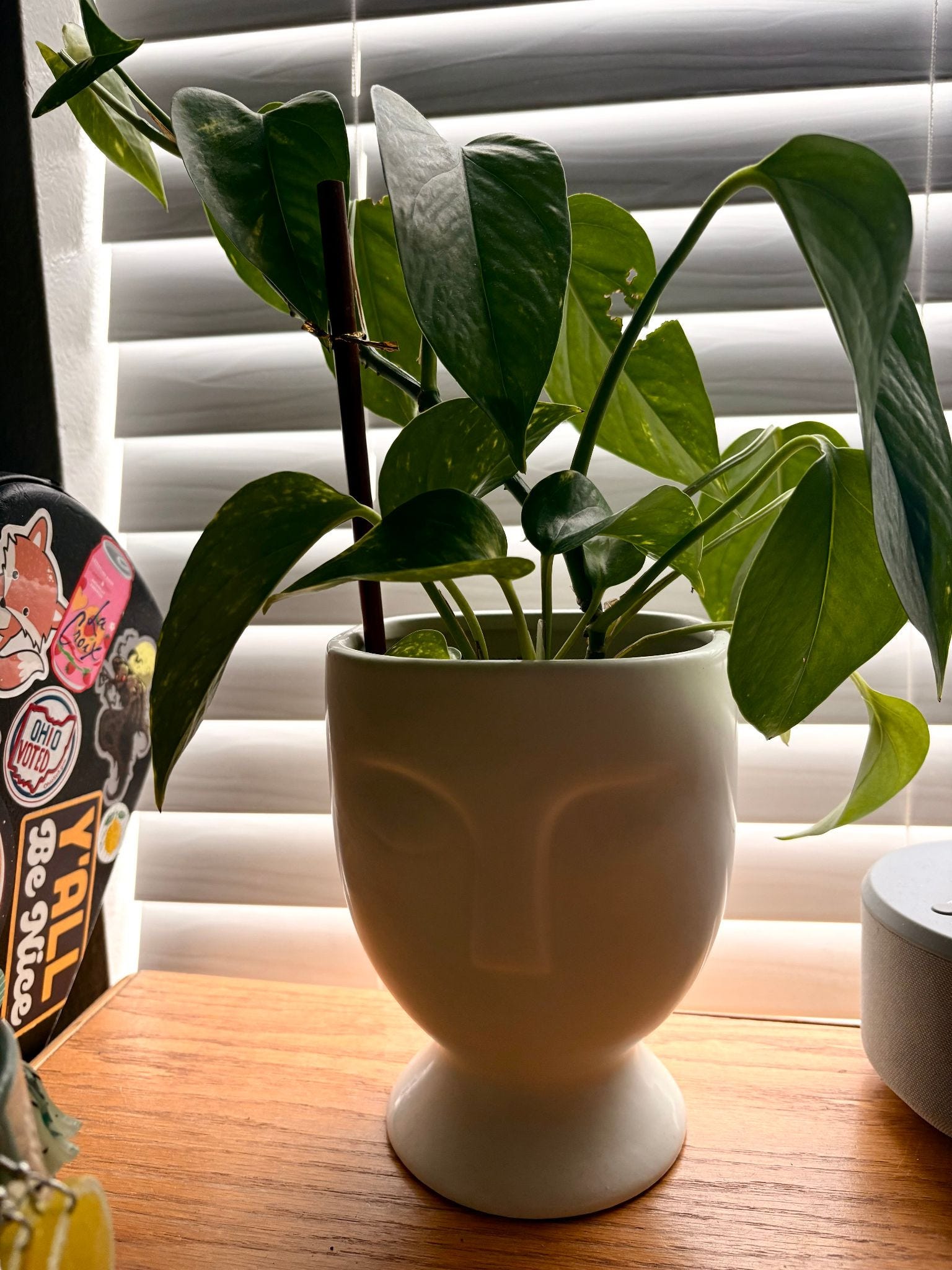
My pothos lives in a vase that looks like the head of a woman. I bought the vase because it made me laugh— if you put a plant in it, it would look like hair. And I had a pothos, which was notorious for draping. She’d make a nice, full head of hair, wouldn’t she?
It turns out that this pothos doesn’t just drape. She reaches her greedy stems out to steal my roommate’s jewelry and covers the nearby desk like the world’s tiniest, most verdant dictator. I’ve given her a chopstick to climb to try and mitigate the invasion, but that hasn’t curbed her ambition one bit.
I am historically not great with plants. I tend to drastically under- or overwater them, then the gnats show up, then the mites, and then I give up and throw the whole thing away. My plant skills failed further when I was diagnosed with an autoimmune disease. Between fatigue and chronic pain, taking care of myself is an accomplishment, let alone another living thing. But this pothos is a survivor. She laughs in the face of dehydration and darkness and welcomes small spiders to her soil.
When I’m coming out of an autoimmune flare—which can mean anywhere from hours to days of nausea, pain, and fatigue that makes sitting up almost impossible—I feel like I’m emerging from a cave. I reacquaint myself with sunlight and remember how to walk upright. I manage to wash my hair and start to put my life back together, because I’ve invariably missed texts and plans and deadlines.
The thing I save for last is checking on my plant.
Each time, I’m convinced that this was the time that I killed her. Sure, she can handle dehydration, but was this the 48 hours that took her from a little neglected to beyond the point of no return?
And every time, she’s sitting there on the sill, waiting for me, flopping dramatically over everything and shoving new leaves between the blinds. She’s just as green and glossy as she’s supposed to be, planning a new campaign to take over my guitar case on the road to world domination.
I probably owe a few people apologies for forgetting something important. I haven’t eaten a vegetable in days. But not all is lost, because at least I didn’t kill the plant. She’s still there for me.
I’ve been thinking about this more and more since I listened to our recent episode featuring Zoë Schlanger. A plant is alive, of course, but can we call them sentient? Seeing as I ascribe a personality to my pothos, I have to say yes. I choose to believe that she is sentient and that she is happy—because there, in her vase, on her sill, she gets to grow.
Such a lovely essay, Hailey!
There's a beautiful rhythm to this story. I love your observations and conclusions. Thank you for sharing your thoughts through the written word.